
Election Advisory No. 2026-06
| To: | All Election Officials | |
| From: | Christina Adkins, Director of Elections |
 |
| Date: | January 26, 2026 | |
| RE: | NEW LAW: Requirements for Certain Ballot Propositions and Related Procedures – Senate Bill 506 | |
In its 89th Regular Session, the Texas Legislature enacted Senate Bill 506 (PDF) (89th Leg., R.S.). This advisory explains changes to requirements and procedures related to ballot propositions as a result of Senate Bill 506.
All statutory references in this advisory are to the Texas Election Code (“the Code”), unless otherwise indicated.
Changes Made to the Election Code as a Result of SB 506
Broadly, SB 506 makes four changes to the Code:
- Creates a new “definiteness, certainty, and facial neutrality” requirement for all Texas ballot propositions. (Sec. 52.072(g)).
- Creates a new procedure through which a registered voter eligible to vote in the election or an authorized representative of a home-rule city can initiate a review of a ballot proposition by the Secretary of State. This process only applies to charter amendments and voter-initiated initiatives or referenda authorized by the home-rule charter. Other ballot propositions—such as propositions for measures that are initiated by a city council that do not amend city charters—are not subject to Secretary of State review. Similarly, ballot propositions in elections other than those for a home-rule city are not subject to review. (Sec. 273.101(a)). The Secretary of State will review the proposition language to determine if it is “misleading, inaccurate, or prejudicial.” (Sec. 273.101(b)).
- Clarifies certain procedure involving lawsuits over the language of ballot propositions. (Secs. 273.102, 273.103, 273.104).
- Prohibits political subdivisions from “obstructing” petition-initiated ballot measures by placing contrary measures on the same ballot. (Sec. 277.005).
SB 506 took effect on September 1, 2025, except for the anti-obstruction provision under Section 277.005 of the Code. The anti-obstruction provision only applies to measures, including a charter amendment, initiated by petitions submitted on or after January 1, 2026.
Definiteness, Certainty, and Facial Neutrality Requirement
SB 506 added Section 52.072(g) to the Texas Election Code. This new subsection provides that ballot propositions “must substantially submit the question with such definiteness, certainty, and facial neutrality that the voters are not misled.” (Sec. 52.072(g)). The new provision applies to all ballot propositions governed by the Code.
The standard in the new subsection is similar to the one that courts have long used when examining ballot propositions. In Dacus v. Parker, 466 S.W.3d 820 (Tex. 2015), for instance, the Texas Supreme Court held that propositions must be “submitted with such definiteness and certainty that voters are not misled.” For entities that write ballot propositions, SB 506 emphasizes that the authors should take care to make sure that the ballot language is clear, definite, and neutral.
Please note that the Secretary of State will not review ballot-proposition language except as is required by Section 273.101 of the Code. Because ballot propositions may require legal expertise to draft, we recommend that counties and local political subdivisions work closely with their attorneys whenever possible.
Secretary of State’s Review Process
SB 506 added Section 273.101 to the Code, which creates a new procedure through which a registered voter eligible to vote in the election or an authorized representative of a home-rule city can initiate a review by the Secretary of State of ballot proposition language that proposes an amendment to the city charter or a voter-initiated initiative or referendum as requested by petition. The procedure to initiate this review is described below and is followed by a Frequently Asked Questions section and a flowchart outlining the deadlines for the review process.
Note: Under Article 11, Section 5(a) of the Texas Constitution, no city charter may be “altered, amended or repealed” more often than every two years. It is the city’s responsibility to track whether it may change its charter under this provision.
The new process for the review of ballot proposition language by the Secretary of State will work as follows:
- What it Covers: The review process covers:
- Ballot propositions proposing amendments to home-rule city charters (whether initiated by city government or by voter-initiated petition); and
- Voter-initiated initiatives or referenda requested by petition in home-rule cities. Other ballot propositions—such as propositions for measures that are initiated by a city council that do not amend city charters—are not subject to Secretary of State review. Similarly, ballot propositions in elections other than those for a home-rule city are not subject to review. (Sec. 273.101(a)).
- Who May Request Review: Only (1) a registered voter eligible to vote in the election in which the proposition will appear; or (2) an authorized representative of a home-rule city may submit the proposition for review by the Secretary of State. (Sec. 273.101(a)).
The list of authorized representatives includes but is not limited to:
- Elected city officials;
- City secretaries;
- City managers;
- City attorneys; and
- Any position designated by city law to be an authorized representative
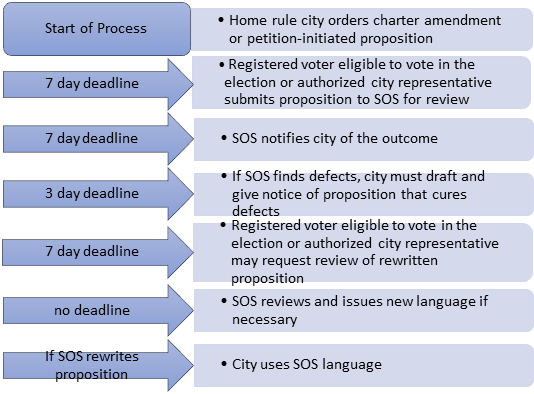
- Deadline to Request Review: A review of ballot proposition language must be requested not later than the seventh day after the date on which the home-rule city orders the ballot proposition. (Sec. 273.101(a)). Because Section 273.101(a) of the Code does not specify that the deadline uses “business days,” weekends and holidays are counted against this deadline. Please note that under Section 1.006, if the last day to request review under the normal deadline is a Saturday, Sunday, or legal state or national holiday, the request is timely if received by the Secretary of State on the next regular business day.
- How to Request a Review: Individuals who want to request Secretary of State review must fill out and sign the Request for Review of Ballot Proposition in Home-Rule City form (Form 25-10 (PDF)). This form is also available in the Secretary of State’s Election Forms Manual . The completed form and all supporting materials should be scanned and submitted by email to the Secretary of State at elections@sos.texas.gov with the subject line “Request for Review of Ballot Proposition.” These materials may also be submitted by mail or in person, but given the condensed timeframe of the review-process deadlines, our office strongly recommends submission by email.
- Nature of Review: The Secretary of State will assess whether the proposition is “misleading, inaccurate, or prejudicial.” (Sec. 273.101(b)).
- Timeline for Response from Secretary of State: The Secretary of State will review the proposition by the seventh day after the date the Secretary receives the submission. If the Secretary of State determines that the proposition is misleading, inaccurate, or prejudicial, the Secretary of State will notify the city. (Sec. 273.101(b)). Under Section 1.006, if the last day to respond under the normal deadline is a Saturday, Sunday, or legal state or national holiday, the response is timely if submitted on the next regular business day.
- Timeline for City’s Response: Not later than the third day after receiving notice from the Secretary of State, the city must draft a proposition to cure the defects and give notice of the new proposition using the method of providing notice prescribed under Section 4.003 of the Code. This means not only posting the new proposition on the city’s website but also publishing it in a newspaper as required by Section 4.003(c) and 4.003(a)(1). Under Section 1.006, if the last day to publish notice under the normal deadline is a Saturday, Sunday, or legal state or national holiday, the notice is timely if published on the next regular business day. (Sec. 273.101(c)). Because of the lead time required to publish the new proposition language in a newspaper, it may often not be possible to publish the revised language before the three-day deadline expires. In that case, the city must still publish the revised proposition in a newspaper as required by Section 4.003 as early as feasibly possible.
Because it will almost always take less time to post the new language on the city’s website than to publish it in a newspaper, the deadline will run from the earlier of the two publication or posting dates. In either case, the city must post the new language on its website within the three-day period after receiving notice from the Secretary of State (unless extended by Section 1.006). Because this posting starts the new deadline period described below, the page on which it is posted should indicate the date that the new language is posted. The city must also notify the Secretary of State of the posting on the same day that it is posted, using the same method of notice that the Secretary of State used to notify the city that the initial proposition was under review.
- Second Review: A voter who is eligible to vote in the election or an authorized representative of a home-rule city qualified to submit the initial proposition for review may submit the rewritten proposition to the Secretary of State for review, using the same procedure as the first proposition, with the same seven-day deadline, except that the seven-day deadline runs from the date that the rewritten proposition language is posted on the city’s website, not from the date that the rewritten language is ordered. (Sec. 273.101(d)). Under Section 1.006, if the last day to submit a request for review under the normal deadline is a Saturday, Sunday, or legal state or national holiday, the submission is timely if received by the Secretary of State on the next regular business day.
- Secretary of State’s Response to the Second Review: If the Secretary of State determines that the city has drafted a proposition under Section 273.101(c) that is misleading, inaccurate, or prejudicial, the Secretary of State must draft the ballot proposition. The statute does not provide a deadline for the Secretary of State to issue the new proposition language. (Sec. 273.101(d)).
- Chart with Deadlines: Below is a flow chart describing the review procedure:
- Safe Harbor for Using the Secretary of State’s Proposition Language: Section 273.102(d) of the Code creates a “safe harbor” provision for cities sued in a mandamus action over their ballot proposition. Under the safe-harbor provision, a city that has received Secretary of State approval of its language—or that uses the Secretary of State’s language—is protected from the risk of having to pay fees and costs if the city later loses a lawsuit over the language of that ballot proposition.
In a mandamus to compel the city’s governing body to substantially submit a ballot proposition with such definiteness, certainty, and facial neutrality that the voters are not misled, if the party seeking to change the proposition wins, the court may choose to award that party attorney’s fees, expenses, and court costs. If a city that has been issued rewritten language does not use the Secretary of State’s language, the city might later be ordered to pay reasonable attorney’s fees, expenses, or court costs if it loses a lawsuit over the ballot-proposition language. Similarly, if the proposition is not reviewed by the Secretary of State (because it was never submitted for review), or it was not submitted for a second review by the Secretary of State after being rewritten by the city following an initial review, reasonable attorney’s fees, expenses, or court costs may be awarded.
In short, getting Secretary of State approval—or using the Secretary of State’s language—protects home-rule cities from the risk of having to pay fees and costs if they later lose a lawsuit over the clarity, definiteness, and facial neutrality of a ballot proposition.
These outcomes are charted below:
| Review Process Outcome | Litigation Risk |
|---|---|
| Proposition never reviewed | City might have to pay fees, expenses, and costs |
| Proposition reviewed and approved by Secretary of State | City protected from risk of paying fees, expenses, and costs |
| Proposition initially rejected by Secretary of State, returned to city for rewrite, and rewritten language not submitted for review | City might have to pay fees, expenses, and costs |
| Secretary of State rewrites proposition after second review and city uses Secretary of State language | City protected from risk of paying fees, expenses, and costs |
| Secretary of State rewrites proposition after second review and city does not use Secretary of State language | City might have to pay fees, expenses, and costs |
- Mandatory Review Period after a Negative Judgment: If a court enters a final non-appealable judgment finding that a ballot proposition drafted by a city did not “substantially submit the question with such definiteness, certainty, and facial neutrality that the voters are not misled," then the Secretary of State must review all of the city’s ballot propositions, regardless of whether they are charter amendments or petition-initiated measures, for four years following the court’s finding. (Sec. 273.103).
This process is described in more detail below in the section entitled “Changes to Judicial Procedures for Proposition-Language Mandamus Actions.”
Frequently Asked Questions on Secretary of State’s Review Process
Q1: Does a city have to rewrite the proposition after the Secretary of State notifies the city that the proposition language is misleading, inaccurate, or prejudicial?
A1: Yes. The city must rewrite the proposition. Section 273.101(c) of the Code provides that “the city shall draft a proposition” to cure the defects identified by the Secretary of State.Q2: What happens if the city does not change the language of the proposition after Secretary of State notification that the original version is misleading?
A2: Although cities have a statutory duty to rewrite a proposition to cure the defects identified by the Secretary of State, the Secretary of State does not have the authority to order a city to rewrite a defective proposition. Only a court can order a city to follow the statute. That said, if a city whose proposition had been identified as defective does not rewrite the proposition to cure the defect, a registered voter who is eligible to vote in the election or an authorized representative of a home-rule city may submit the ballot language to the Secretary of State, which will cause the Secretary of State to rewrite the proposition under Section 273.101(d) of the Code.Q3: Can a registered voter who is eligible to vote in the election or an authorized representative of a home-rule city seek Secretary of State review of a ballot proposition after the measure it describes has passed?
A3: No. Section 273.101(a) of the Code requires challengers to submit a proposition for review no more than seven days after the proposition has been published.Q4: Can a registered voter who is eligible to vote in the election or an authorized representative of a home-rule city seek Secretary of State review of propositions other than from home-rule cities?
A4: No. Under 273.101(a) of the Code, only ballot propositions proposing amendments to home-rule city charters and voter-initiated initiatives or referenda requested by petition in home-rule cities will be reviewed by the Secretary of State. This means that there are many types of ballot propositions—such as party referenda, establishing elections for local entities, bond and tax propositions, and state constitutional amendments (among others)—that are not subject to review by the Secretary of State.Q5: Does the same person who initiated the first request for review by the Secretary of State have to initiate the second review?
A5: No. Any registered voter eligible to vote in the election or an authorized city representative may submit a request for review after the Secretary of State has found that the original proposition language is defective.Q6: Is there an administrative appeal process after the Secretary of State issues a decision on whether a proposition is misleading, inaccurate, or prejudicial?
A6: No. The Texas Election Code does not create an administrative appeal process for a decision by the Secretary of State.Q7: Will the Secretary of State provide foreign-language translations of the propositions it rewrites under Section 273.101(d) of the Code?
A7: No. If the Secretary of State rewrites a proposition, it will provide only an English-language version of the new proposition. It is the responsibility of the city to translate the Secretary’s proposition into required foreign languages.Changes to Judicial Procedures for Proposition-Language Mandamus Actions
SB 506 clarifies the procedures a court will use in a lawsuit over ballot-proposition language. Specifically, it defines the procedures used in a mandamus action to compel the city’s governing body to comply with the requirement that a ballot proposition must substantially submit the question with such “definiteness, certainty, and facial neutrality” that the voters are not misled. A mandamus is a motion used to compel a government official to perform a required action.
SB 506 makes the following clarifications to mandamus actions challenging the language of ballot propositions:
- Court’s decision must be made “without delay”: Section 273.102(a) of the Code provides that the court shall make its determination without delay.
- Courts can rewrite proposition language: Section 273.102(a) also clarifies that a court may order a city to use the ballot proposition language drafted by the court in response to a mandamus.
- Courts can order city to pay attorney’s fees, expenses, or court costs: Section 273.102(b) and 273.102(c) waives and abolishes a city’s governmental immunity so that the city can be ordered to pay the suing party’s reasonable attorney’s fees, expenses, and court costs, but not other costs or damages.
- The city must pay for legal services: Section 273.104 provides that a city may not accept legal services for a mandamus challenge to proposition language without paying fair market value for those services, even if a home-rule city charter provision indicates otherwise.
- Mandatory four-year review period after judgment against a city: As noted above, Section 273.103 provides that if a court issues a final, non-appealable judgment finding that a city-drafted ballot proposition failed to substantially submit the question to the voters with adequate definiteness, certainty, and facial neutrality that the voters are not misled, then the city must submit any proposition to the Secretary of State for review. This requirement covers all propositions to be voted on at an election held by the city before the fourth anniversary of the court’s finding. The review process after a negative judgment is otherwise the same as a voter- or city representative-initiated review.
Under Section 273.103, it is the city that has the responsibility to submit propositions to the Secretary of State. Any city found to have substantially misled the voters with its ballot language in a final non-appealable judgment must therefore send the Secretary of State a copy of the judgment and all other relevant documents.
Anti-Obstruction Provision (Election Code Section 277.005)
Section 277.005 of the Code creates a new anti-obstruction provision that limits the authority of political subdivisions to order measures, including a charter amendment, that may obstruct a petition-initiated measure on the same ballot. The provision is described below and followed by a Frequently Asked Questions section.
- Definition of Obstruction: Section 277.005 prevents a political subdivision from ordering a measure, including a charter amendment, that will appear on the same ballot as a petition-initiated measure if:
- the two measures generally address the same subject matter; or
- a provision of a proposed measure would invalidate or conflict with any portion of a petition-initiated measure.
- Timing: An obstructive measure proposed by a political subdivision is void if the measure is proposed not earlier than the 180th day before the date the political subdivision’s secretary receives the petition under Chapter 277. Please note that the Code does not prohibit a political subdivision from placing a measure on a ballot in a later election.
- Remedy: A political subdivision may be enjoined from proposing the measure. This means that an opponent of an obstructive measure could go to court to stop the measure from being placed on the ballot. The Secretary of State is not a judicial officer, and has no authority to order a political subdivision not to place an obstructive measure on the ballot.
- Effective Date: Although SB 506 took effect on September 1, 2025, the anti-obstruction provision only applies to measures initiated by petitions submitted on or after January 1, 2026.
- Petition Procedures: SB 506 does not change the provisions in the Texas Election Code governing petitions, which are in Chapter 277. These provisions provide additional limits on the power of home-rule cities to obstruct voter-initiated propositions. In particular, Section 277.004 prevents cities from adding requirements “for the validity or verification of petition signatures” by providing that additional signature requirements prescribed by a home-rule city charter provision or a city ordinance are effective only if the charter provision or ordinance was in effect by September 1, 1985.
Frequently Asked Questions Regarding the Anti-Obstruction Provision (Election Code Section 277.005)
Q1: Can the Secretary of State order a city not to place a potentially obstructive measure on the ballot?
A1: No. The Secretary of State is not a judicial officer, and has no authority to order a political subdivision not to place an obstructive measure on the ballot. An individual who believes that a proposition should be removed from the ballot or altered under Section 277.005 of the Code should go to court.Q2: Will the Secretary of State review the language of a measure to determine whether it violates the anti-obstruction rule?
A2: No. The Secretary of State has no statutory mandate to review measures for obstruction and will not review the language of a proposed measure to evaluate whether it obstructs another measure. Even if the proposition describing a potentially obstructive measure is submitted for review under Section 273.101(a) of the Code, the Secretary of State will not review whether the measure is obstructive. It will only review the proposition to ascertain whether it is misleading, inaccurate, or prejudicial.If you have any questions or circumstances that are not covered by this advisory, please do not hesitate to contact the Elections Division toll-free at 1-800-252-2216.
CA:CP:JG


